UPSC Mathematics Optional 2026: The Ultimate Guide to 300+ Marks
Choosing Mathematics as your UPSC optional is a high-stakes, high-reward decision. It is one of the few subjects where scoring 300+ marks is a realistic goal due to its objective nature. However, the vast syllabus requires a disciplined, “engineer-like” precision in your preparation.
If you are searching for:
- UPSC Maths Optional strategy
- Real Analysis / Complex Analysis preparation
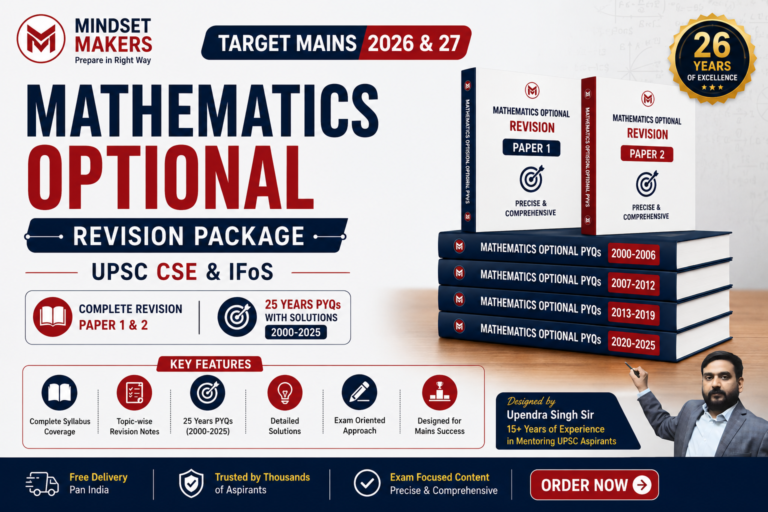
- PYQ solutions and topper guidance
Why Choose Mathematics Optional for UPSC?
Mathematics is not just another optional — it is a rank-deciding subject.
Key Advantages:
Choosing Mathematics as your optional is a strategic move that can significantly boost your overall UPSC rank. Unlike descriptive subjects where marks often hit a “ceiling,” Mathematics offers a level of transparency and scoring potential that is unmatched.
High Scoring Potential (The “300+” Factor)
The most compelling reason to choose Maths is its mathematical certainty. In humanities subjects, your marks depend on the examiner’s perspective, your writing style, and the “subjectivity” of your arguments. In Mathematics, if you arrive at the correct answer through logical steps, the examiner is compelled to give you near-full marks. It is one of the few optionals where scores of 320–350 are consistently achievable.
Immunity to “Scaling” and Subjectivity
The UPSC uses a scaling system to normalize marks across different subjects. Since Mathematics is objective, it is less prone to the erratic swings of “liberal” or “strict” marking that often affect subjects like Sociology or Geography. Your performance is in your hands; if you solve 80% of the paper correctly, your score will reflect that without being dampened by an examiner’s personal bias.
Static and Predictable Syllabus
Unlike subjects like Political Science or Economics, the Mathematics syllabus is 100% static.
- The principles of Linear Algebra or Vector Analysis do not change with current affairs.
- Once you have mastered a topic and its theorems, you don’t need to constantly update your notes with newspapers or yearbooks.
- This makes the revision process highly efficient in the final months before the Mains.
Overlap with Logical Reasoning (CSAT)
While the optional syllabus is much more advanced, the “mathematical mindset” you develop makes Paper II (CSAT) in the Prelims a breeze. You will find yourself solving the Quantitative Aptitude and Logical Reasoning sections with significantly higher speed and accuracy than other candidates, saving you precious time and reducing Prelims-day stress.
High Return on Investment (ROI)
The initial learning curve for Mathematics is steep, and it requires more hours of study than other subjects. However, the ROI is higher because:
- Repetitive Patterns: Approximately 60% of the questions are variations of Previous Year Questions (PYQs).
- Defined Boundaries: You know exactly what to expect. There are no “surprise” questions from outside the standard textbooks.
- Logical Satisfaction: For those with a background in Engineering or Science, practicing Maths acts as a “brain break” from the heavy reading required for General Studies (GS).
Precision in Answer Writing
In General Studies, you often have to write long, 250-word essays where the structure can be vague. In Mathematics, the structure is dictated by the logic of the problem. This clarity of thought often spills over into your GS papers, helping you write more structured, concise, and logical answers.
A Quick Reality Check:
While these advantages are significant, they only apply if you have a genuine interest in the subject. Success in Maths comes from the joy of problem-solving; without that, the vast syllabus can feel overwhelming.
Given your background, do you feel more comfortable with the Applied topics (like Fluid Dynamics and Mechanics) or the Abstract side of things (like Modern Algebra and Real Analysis)?
People also search
Is Mathematics Optional a good choice for UPSC 2026-2027?
The Answer: Yes. Mathematics remains one of the highest-scoring optionals. In recent years (2024-2025), toppers have consistently scored 320+ marks. It is ideal for those with a background in Engineering or B.Sc. Maths because the syllabus is 100% static and marks are awarded objectively for correct steps.
Can I clear UPSC Maths Optional without coaching?
The Answer: Absolutely. While coaching provides a structured path, many aspirants clear it using standard Text MindsetMakers (like Upendra Sir for ODE/PDE and X for Algebra) and YouTube. The key is to solve 20 years of PYQs (Previous Year Questions) and join a Test Series for Paper-II, which is often more abstract and harder to self-evaluate.
Is there step-wise marking in UPSC Mathematics?
The Answer: Yes, UPSC follows a strict step-marking policy. Even if your final numerical answer is wrong due to a minor calculation slip, you can still secure 60–70% of the marks if your method, theorems used, and logical flow are correct.
Which calculator is allowed in UPSC Mains for Mathematics?
The Answer: Candidates are allowed to use a non-programmable scientific calculator for both Paper I and Paper II. Popular choices include the Casio fx-82MS or fx-100MS. You should start using your calculator during daily practice to build speed and familiarity.
How much time is required to finish the UPSC Maths syllabus?
The Answer: On average, it takes 6 to 8 months of dedicated study (4-5 hours daily) to cover the syllabus once. However, since Maths requires multiple rounds of practice, it is recommended to start at least 12 months before your Prelims so that you can finish the optional syllabus and one round of revision by January of your attempt year.