
How to Prepare Simple Harmonic Motion (SHM) for UPSC CSE & IFoS Mathematics Optional
Hello dears. Whenever students open Dynamics for UPSC CSE or IFoS Mathematics Optional, Simple Harmonic Motion looks very simple on the first day. You read the standard equation \(\frac{d^2x}{dt^2}=-\mu x\), memorize the time period \(\frac{2\pi}{\sqrt{\mu}}\), and feel confident. Then you sit in the exam hall, read a question on vertical elastic strings, and get completely stuck on signs and limits.
Why does that happen? Because UPSC and IFoS rarely ask a plain textbook question where a particle just oscillates back and forth from start to finish. They test composite motion—where the string goes slack for half the journey and becomes taut for the other half. If you try to solve these problems by memorizing formulas, you will get trapped. Instead, you have to do a small mental exercise first, extract the keywords, and break the motion into clean physical stories.
Let us take Model Example (1) from Category (3) of our Dynamics literature to see how to prepare SHM the right way.
Model Example (1): Vertical Elastic String (Slack-to-Taut Transition)
One end A of a weightless elastic string AB, having natural length l, is fixed to a rigid support. When a particle of weight W is suspended freely from the lower end B, the string stretches to a total length of 2l. Suppose instead that a smaller weight of W/4 is attached to B, raised vertically up to the level of the fixed point A, and released from rest. Show that:
- The resulting Simple Harmonic Motion has an amplitude of 3l/4;
- The total vertical distance covered by the weight before coming to instantaneous rest is 2l; and
- The time period of one complete oscillation is;

Teacher’s Words: How to Think Before Writing a Single Equation
Hello students! Here we do not want to jump directly into the answer. First we will do some mental exercise. Draw the keywords from the question: weightless elastic string AB of natural length l; weight W stretches it to 2l; smaller weight W/4 released from rest at A.
Do not treat this as one single motion. Separate it into three small stories in your mind:
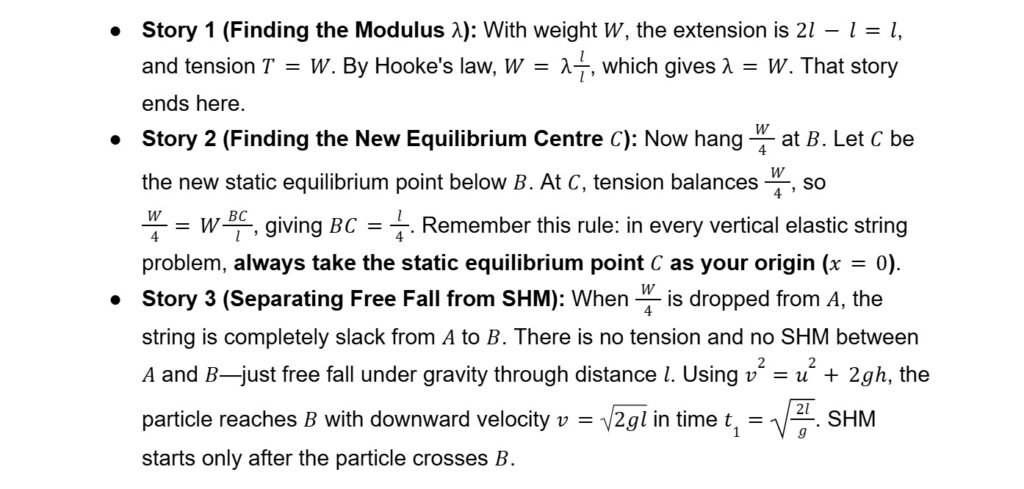
Setting Up the SHM Equation and Watching Your Signs
Once the particle passes below B, the string becomes taut. Take C as the origin and measure displacement x vertically downwards. At any point P at distance x below C, the total extension of the string from its natural length l is \(\left(\frac{l}{4}+x\right)\), so the upward tension is:
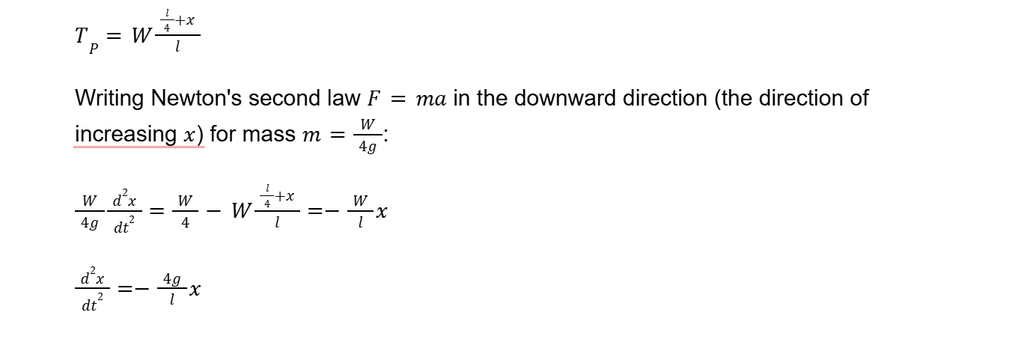

From here, all three parts fall out naturally:
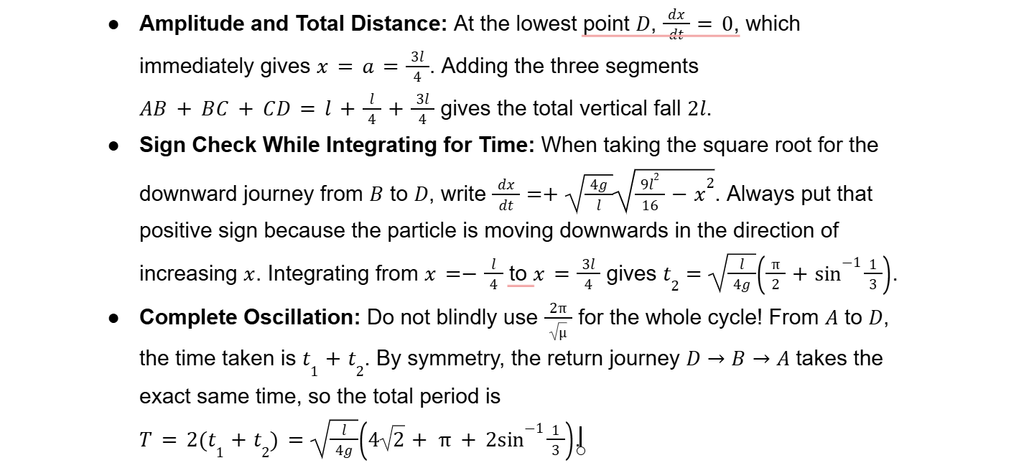
Three Rules to Follow While Practicing SHM
If you want full marks in Dynamics for UPSC CSE and IFoS, follow this exact checklist for every SHM problem you practice:
- Never jump into \(\frac{d^2x}{dt^2}=-\mu x\) before checking whether the string is taut. Always separate the slack portion (free fall) from the taut portion (SHM).
- Fix the static equilibrium position as your origin x=0 before writing Hooke’s law at a general point P.
- Check the sign of
dx/dtbefore integrating for time. If x is increasing during that interval, take the positive root; if x is decreasing, take the negative root.
Study Complete Dynamics With Mindset Makers

Want to practice every category of Dynamics—from Vertical Elastic Strings and Inverse-Square Law of Attraction to Resisted Motion and Central Orbits—in this exact step-by-step sequence with 26 years of UPSC CSE & IFoS Previous Year Questions?
- Explore the 16+1 Core Literature Book Set: Systematically typeset physical volumes covering Theory, Categorical Model Examples, 26-Year Chapter-Wise PYQs, and Short Revision Notes at Mindset Makers Core Literature Books.