Write Dynamics Answers in UPSC Mathematics Optional Mains
Why Skipping Two Lines in Dynamics Costs You 10 Marks in UPSC Mains—And How to Write Examiner-Proof Solutions
Hello dears,
After seeing how UPSC repeats and generalizes Simple Harmonic Motion questions across CSE and IFoS, we arrive at the most common complaint I hear from Mains test-series students: “Sir, my final answer matched the textbook, yet I only got 6 out of 15 marks.” Having reviewed thousands of answer booklets at Mindset Makers Academy, I always tell them the same truth. In Applied Mathematics papers like Dynamics, UPSC examiners do not merely glance at your final boxed expression—they grade your mathematical reasoning line by line.
When an aspirant jumps straight to T = 2π/√μ, quotes an amplitude formula without proving Simple Harmonic Motion from m(d²x/dt²) = -μx, or fails to state why a negative square root was chosen during an inward journey, the examiner deducts marks immediately for missing logic. Across our human-evaluated test program and inside the Mindset Makers 16+1 Books, we reject the coaching industry’s habit of skipping definitions for quick shortcuts.
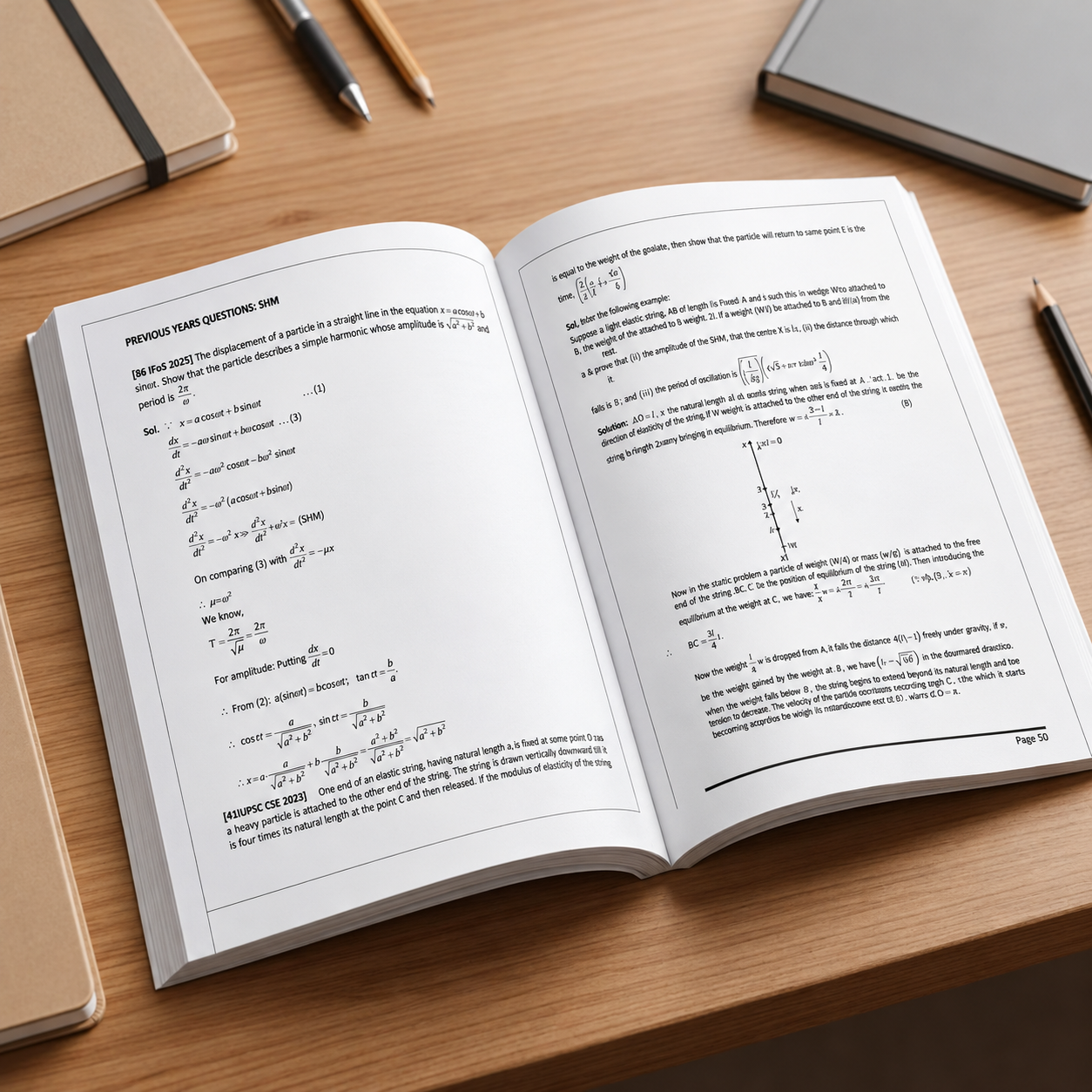
How to present complete solutions using actual UPSC PYQs.
Instead, every single PYQ solution in our Dynamics module follows a clear, natural four-part writing rhythm. Before writing a single equation, always extract the keywords cleanly—the fixed point, natural length, modulus λ, initial velocity, and your chosen origin. Next, build the derivation from first principles, establishing Hooke’s law equilibrium first and then writing Newton’s second law (F = ma) in the exact direction of increasing displacement x to prove d²x/dt² = -μx. Third, write explicit sign and interval justifications right where marks are won or lost, stating clearly where the string goes slack (x < -a) and why dx/dt takes a positive or negative sign before separating variables. Finally, carry every trigonometric, integral, and determinant step cleanly to the end—from Vandermonde determinants in IFoS 2018 Q.5(c) to definite integral bounds on a simple pendulum in UPSC CSE 2019 Q.7(c).
Writing with this patience turns an average answer sheet into a 300+ worthy copy. In the fourth and final part of this series, I will share the exact category weightage and the 26-year Master Checklist from our book so you can test your own preparation in ten minutes.
Prepare in the right way. Keep learning, keep smiling.
— Prof. Upendra Singh (Upendra Sir)
Founder & Director, Mindset Makers Academy
Simple Harmonic Motion for UPSC Maths Optional: SHM Problems
How to Prepare Simple Harmonic Motion (SHM) for UPSC CSE & IFoS Mathematics Optional
Hello dears. Whenever students open Dynamics for UPSC CSE or IFoS Mathematics Optional, Simple Harmonic Motion looks very simple on the first day. You read the standard equation \(\frac{d^2x}{dt^2}=-\mu x\), memorize the time period \(\frac{2\pi}{\sqrt{\mu}}\), and feel confident. Then you sit in the exam hall, read a question on vertical elastic strings, and get completely stuck on signs and limits.
Why does that happen? Because UPSC and IFoS rarely ask a plain textbook question where a particle just oscillates back and forth from start to finish. They test composite motion—where the string goes slack for half the journey and becomes taut for the other half. If you try to solve these problems by memorizing formulas, you will get trapped. Instead, you have to do a small mental exercise first, extract the keywords, and break the motion into clean physical stories.
Let us take Model Example (1) from Category (3) of our Dynamics literature to see how to prepare SHM the right way.
Model Example (1): Vertical Elastic String (Slack-to-Taut Transition)
One end A of a weightless elastic string AB, having natural length l, is fixed to a rigid support. When a particle of weight W is suspended freely from the lower end B, the string stretches to a total length of 2l. Suppose instead that a smaller weight of W/4 is attached to B, raised vertically up to the level of the fixed point A, and released from rest. Show that:
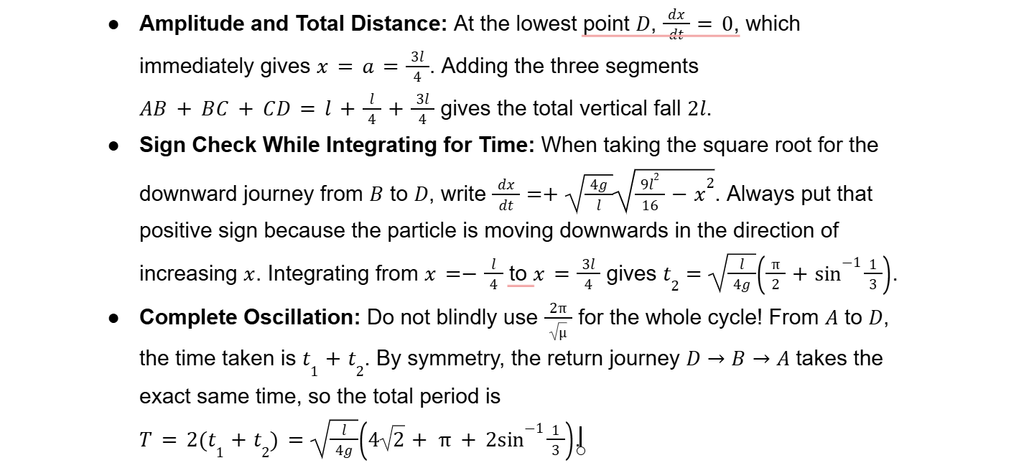
The resulting Simple Harmonic Motion has an amplitude of 3l/4;
The total vertical distance covered by the weight before coming to instantaneous rest is 2l; and
The time period of one complete oscillation is;
Teacher’s Words: How to Think Before Writing a Single Equation
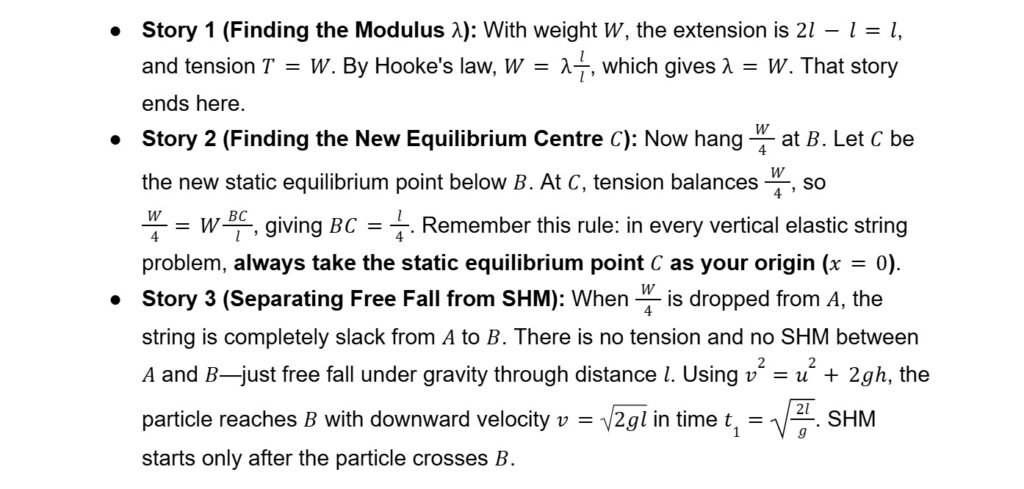
Hello students! Here we do not want to jump directly into the answer. First we will do some mental exercise. Draw the keywords from the question: weightless elastic string AB of natural length l; weight W stretches it to 2l; smaller weight W/4 released from rest at A.
Do not treat this as one single motion. Separate it into three small stories in your mind:
Setting Up the SHM Equation and Watching Your Signs
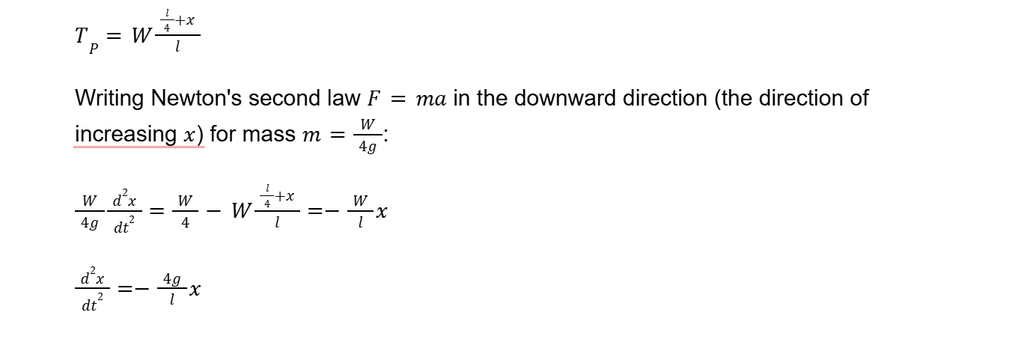
Once the particle passes below B, the string becomes taut. Take C as the origin and measure displacement x vertically downwards. At any point P at distance x below C, the total extension of the string from its natural length l is \(\left(\frac{l}{4}+x\right)\), so the upward tension is:
From here, all three parts fall out naturally:
Three Rules to Follow While Practicing SHM
If you want full marks in Dynamics for UPSC CSE and IFoS, follow this exact checklist for every SHM problem you practice:
Never jump into\(\frac{d^2x}{dt^2}=-\mu x\)before checking whether the string is taut. Always separate the slack portion (free fall) from the taut portion (SHM).
Fix the static equilibrium position as your originx=0 before writing Hooke’s law at a general point P.
Check the sign ofdx/dtbefore integrating for time. If x is increasing during that interval, take the positive root; if x is decreasing, take the negative root.
Study Complete Dynamics With Mindset Makers
Want to practice every category of Dynamics—from Vertical Elastic Strings and Inverse-Square Law of Attraction to Resisted Motion and Central Orbits—in this exact step-by-step sequence with 26 years of UPSC CSE & IFoS Previous Year Questions?
Explore the 16+1 Core Literature Book Set: Systematically typeset physical volumes covering Theory, Categorical Model Examples, 26-Year Chapter-Wise PYQs, and Short Revision Notes at Mindset Makers Core Literature Books.
Systems of Linear Equations in Linear Algebra | UPSC Maths
Systems of Linear Equations: UPSC Mathematics Optional: Teacher’s words to prepare in right way
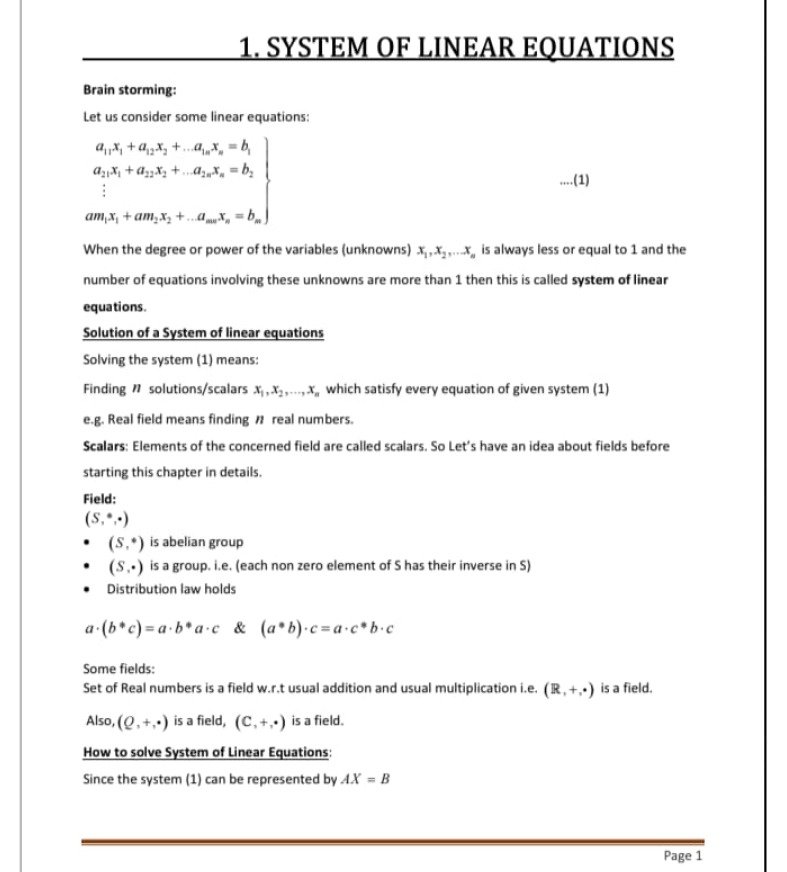
Let’s say I have given you some equation, and then I give you another one. Why have I written this? Because our childhood was like this, when we grew up we got here, and today we are going to get here. What is the target? When you were young, your teacher said, “Solve this equation.” You used to think these were just equations. Now that you have grown up, you are told that if you have more than one thing, you will call it a system of things.
Understand this carefully. Here we have two equations, so this is a system of two equations. There may be a system of three equations or a system of m number of equations, right? Understand my point carefully: this is a system of two linear equations, my dear fellows. When I use the word linear, it means whatever variables you are taking—x, y, z—their power is one. That is in linear form. If the powers of x and y are one, then it is called a linear equation. These variables whose values you want to find out are called unknowns.
So here we have a system of three linear equations in three unknowns. And in general, we have m linear equations in n unknowns—whatever unknowns we have, from \(x_1\) to \(x_n\).
What Does Solving a System Mean?
Understand it carefully: “Solve the given system of linear equations.” What is the meaning of this, my dear fellows? The meaning is to find the values of the unknowns that satisfy each of the given equations. The simple meaning of solving the system is just this.
Now, look at how your childhood was spent, friend. You used to multiply equation one by two, subtract it from equation two, and eliminate a variable. In three equations, you used to eliminate x and y and then solve it. But that childhood method is not useful here. Why will we not do it that way? Because up to three unknowns and three equations, it is fair enough. But when you have 100 unknowns and 150 equations, how can you do that manually? Are you getting my point? That is not possible manually. In that case, you have to develop some algorithm. A systematic approach will have to be developed so that whatever the number of unknowns in the equation, you feed that in and get your answer.
Matrix Representation: AX=B
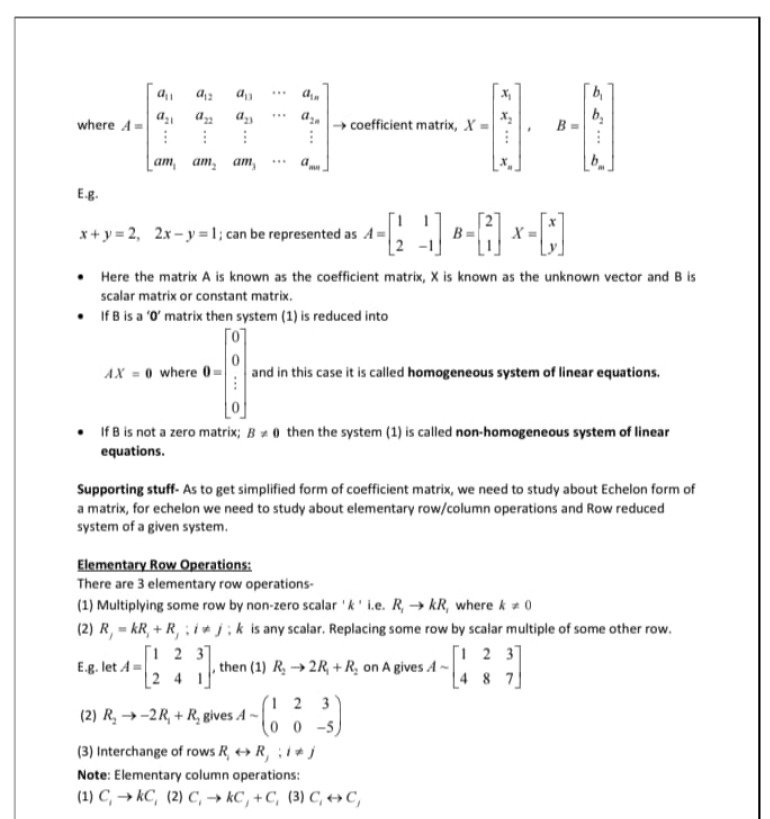
To do this, observe this system carefully. This system can be represented in the form of a matrix if I take the coefficients, and I hope you know how to multiply two matrices, right? If you observe, x+2y=2 and the second equation can be written in matrix form. Similarly, if you observe the three-equation system, this will be written as a 3×3 matrix multiplied by the column of x,y,z equal to the right-hand side.
AX=B; x+y=2, 2x-y=1
So here we will have \(x_1, x_2, \dots, x_n\) on the left, and it goes to \(b_1, b_2, \dots, b_m\) on the right. This means a system of linear equations can be represented like this.
If I call this coefficient matrix capital A, if I call this unknown column vector capital X, and if I call this right-hand side column capital B, then what we have discussed till now is that whenever we are given a system of linear equations, it can always be reflected in the form:
AX=B
Is everything clear till here? Here, A is called the coefficient matrix, X is the unknown vector, and B is the constant or RHS vector. Note that if B is a zero matrix, the system reduces to AX=0 and is called a homogeneous system of linear equations; if \(B \neq 0\), it is called a non-homogeneous system.
Demand-Driven Learning and Elementary Row Operations
Now understand carefully how we solve it. See, the story is the same as that of childhood, just a little bit more systematic here. Suppose you want to solve this system AX=B. Basically, we try to reduce A into a simpler form. Look, first we will create the demand, and then we will see why this topic is being read. The right way to learn anything is just like a child.
If I ask you what you did to solve the equations in childhood, you multiplied an equation by two and subtracted it, which ultimately eliminated x from the second equation. You got something in a simpler form. Now, when you multiplied everything in each equation, you have to give that step a formal name; only then can you develop a systematic approach.
We do this by applying row and column operations. Traditionally, we mainly work with row operations. It is not the case that we cannot do it with columns—we can—but row operations are traditional in this work, so we will go with that. That is why we said learning should be demand-driven. Now we have come to Elementary Row Operations.
My dear fellows, there are three elementary row operations. Understand what those are:
1. Scaling a Row
If I replace the i-th row (whether it is the first, fourth, fifth, or tenth row) by k times that row, where k is a non-zero scalar:
\(R_i \rightarrow kR_i (k \neq 0\))
When you do that with a matrix, this is called an elementary row operation. Suppose we are working on AX=B. When you multiplied an equation by two in childhood, you did not just multiply the left side; you worked with the coefficients and also the things available in the RHS. So basically, you write an augmented matrix where you apply the operation on the coefficients and simultaneously operate on what is available in the RHS. For example, if I say \(R_1 \rightarrow 2R_1 \) we multiply the first row by 2 and keep the second row as it is. This is the first elementary row operation.
2. Adding a Multiple of One Row to Another
Now I move on to the second elementary row operation. Understand carefully what it does. I replace the j-th row by adding k times the i-th row to the j-th row, where k is non-zero and \(i \neq j\):
You might be wondering what this means. For example, \(R_2 \rightarrow R_2 – R_1\). You used to do the exact same thing in your childhood! You might say, “Sir, there is subtraction in maths, why are you writing addition?” Well, in maths, there are really only addition and multiplication, and subtraction is just adding the additive inverse. So basically, the work is the same as multiplying equation one by two and subtracting it from equation two, but to formalize that, we write it like this. So the first row remains unchanged, and \(R_2\) is operated on to produce zeros below the first entry.
3. Interchange of Rows
The third elementary row operation is the interchange of rows:
\(R_i \leftrightarrow R_j\)
Look, we had a habit in childhood—I don’t know whether it was yours or not—that suppose I am given some equations, and one of them has a leading coefficient of 1. I felt happier solving the system by making that equation number one. So what I mean to say is you can freely interchange any two rows to bring a simpler equation to the top.
Study Complete Linear Algebra With Mindset Makers Academy
Want to master every categorical example, Echelon Form reduction, and 26 years of UPSC CSE & IFoS Previous Year Questions in this exact step-by-step sequence?
Get the Complete 16+1 Core Literature Book Set: Systematically typeset physical volumes covering Theory, Categorical Examples, 26-Year Chapter-Wise PYQs, and Short Revision Notes. Explore the 16+1 Books →
Join the 2027 & 2028 Evaluation Tracks: Practice answer writing under strict Sunday schedules with 48-hour copy evaluations and final macro audits by Prof. Upendra Singh. View Test Programs →
Best Books for UPSC Maths Optional 2026 (Paper 1 & 2) + 26+ Years PYQs | Complete Guide
Preparing for the UPSC Civil Services Examination with Mathematics optional is a smart choice—but only if your preparation is structured.
What UPSC Actually Demands in Mathematics Optional
Most aspirants misunderstand the core demand of UPSC when it comes to Mathematics Optional. They assume success depends on the number of books they complete or the volume of content they consume.
But the reality is very different.
UPSC is not a quantity-driven exam. It is a precision-driven exam.
It evaluates how well you understand, apply, and present mathematics — not how much you have read.
What UPSC Really Tests
1. Concept Clarity (Foundation Matters Most)
UPSC questions are rarely direct repetitions of textbook examples. Instead, they are designed to test your depth of understanding.
Can you connect concepts across topics?
Can you derive results when formulas are not directly applicable?
Do you understand the “why” behind every theorem?
Aspirants who rely on rote learning often struggle here.
Those with strong conceptual clarity can handle even unfamiliar problems with confidence.
2. Problem-Solving Accuracy (Not Attempts, but Correct Attempts)
In Mathematics Optional, accuracy is everything.
A small mistake can cost full marks.
Partial knowledge often leads to wrong conclusions.
UPSC rewards clean, correct, and logically sound solutions.
This means:
You must practice enough to reduce errors.
Your steps should be logically structured and easy to evaluate.
3. Speed + Structured Answer Writing (The Real Game-Changer)
Even if you know everything, poor time management can ruin your paper.
UPSC tests:
How quickly you can interpret a problem
How efficiently you can solve it
How clearly you present your solution
A good answer is:
Step-wise
Neatly structured
Easy for the examiner to follow
This is where most aspirants lose marks — not due to lack of knowledge, but poor execution under time pressure.
Best Books for UPSC Maths Optional (Paper 1)
Paper 1 is the core foundation of Mathematics Optional. If your basics are strong here, Paper 2 automatically becomes more manageable.
It covers key subjects like:
Linear Algebra
Calculus
Analytical Geometry
Differential Equations
Vector Calculus
Most aspirants make a critical mistake at this stage — they try to cover too many books for each subject. This creates confusion instead of clarity.
But UPSC doesn’t reward how many sources you study.
It rewards how well you understand and apply concepts.
The Right Approach to Book Selection
Instead of collecting multiple resources, follow a simple and proven strategy:
👉 One Standard Book per Subject + Multiple Revisions
Why this works:
Reduces confusion and mental overload
Builds deep conceptual clarity
Improves retention through repetition
Saves time for answer writing and PYQ practice
Subject-wise Smart Strategy (Paper 1)
1. Linear Algebra
Focus on:
Vector spaces, eigenvalues, eigenvectors
Diagonalization and matrix theory
What UPSC expects: Conceptual understanding + direct application
Preparation tip: Solve problems repeatedly until methods become instinctive.
2. Calculus
This is one of the most scoring yet tricky areas.
Focus on:
Limits, continuity, differentiability
Mean Value Theorems
Definite & indefinite integration
What UPSC tests: Concept clarity + problem interpretation
Preparation tip: Don’t just solve — understand why each step works.
3. Analytical Geometry
Focus on:
2D and 3D geometry
Conic sections, lines, planes
What UPSC expects: Visualization + equation-based problem solving
Preparation tip: Practice diagrams mentally — it boosts speed in exams.
4. Differential Equations
Focus on:
First-order and higher-order differential equations
Standard forms and solution techniques
What UPSC tests: Method selection + accuracy
Preparation tip: Identify patterns — most questions follow predictable methods.
5. Vector Calculus
Focus on:
Gradient, divergence, curl
Line and surface integrals
What UPSC expects: Concept application + formula usage
Preparation tip: Revise formulas regularly and apply them in PYQs.
Best Books for UPSC Maths Optional (Paper 2)
Paper 2 is where many aspirants either gain a strong advantage or lose marks due to lack of clarity.
Unlike Paper 1 (which is more computational), Paper 2 is:
👉 Concept-driven
👉 Theory-heavy
👉 Highly scoring if prepared the right way
It includes:
Modern Algebra
Real Analysis
Complex Analysis
Partial Differential Equations (PDE)
Numerical Analysis
What Makes Paper 2 Different?
In Paper 2, UPSC is not just testing your ability to solve problems.
It evaluates:
How clearly you understand definitions and theorems
Whether you can apply concepts logically
How well you can present structured mathematical arguments
A student with strong conceptual clarity can score very high here — even with limited resources.
The Right Book Strategy for Paper 2
Most aspirants struggle here because they:
Keep switching books
Try to cover too many sources
Ignore revision and PYQs
👉 The smarter approach is:
Stick to One Standard Source + Structured Preparation
Tip: Understand proofs instead of memorizing them blindly.
2. Real Analysis
This is one of the most challenging yet rewarding sections.
Focus on:
Sequences and series
Continuity, differentiability
Riemann integration
UPSC Demand: Precision in definitions + logical reasoning
Tip: Practice writing definitions in your own words for better retention.
3. Complex Analysis
Focus on:
Analytic functions
Cauchy’s theorem and integrals
Residue theorem
UPSC Demand: Concept + application balance
Tip: Revise formulas and standard results regularly.
4. Partial Differential Equations (PDE)
Focus on:
Standard forms and methods
Classification of PDEs
UPSC Demand: Method identification + accuracy
Tip: Practice pattern recognition — many questions follow similar structures.
5. Numerical Analysis
Focus on:
Interpolation
Numerical solutions of equations
Error analysis
UPSC Demand: Accuracy + step-wise solving
Tip: Keep your steps neat and systematic — presentation matters a lot.
Why 18+ Years PYQs Are Non-Negotiable in UPSC Maths Optional
If you’re not solving Previous Year Questions (PYQs), you’re not preparing for the exam — you’re just studying mathematics in isolation.
UPSC doesn’t ask random questions. It follows patterns.
And PYQs are the only reliable source to understand those patterns.
What 18+ Years PYQs Actually Do
✔ Reveal Repeating Patterns
UPSC Mathematics Optional has a pattern-based structure.
Certain concepts are asked again and again
Question types often repeat with slight variations
Some topics carry consistent weightage every year
When you solve PYQs, you start recognizing:
👉 “This type of question has already been asked before.”
Highlight Important Topics
Not every topic in the syllabus is equally important.
PYQs help you identify:
High-weightage areas
Frequently asked concepts
Topics that require deeper preparation
Instead of guessing what’s important, you prepare based on actual UPSC trends.
Improve Answer Writing Speed
Many aspirants know the solution but fail to complete the paper on time.
PYQs train you to:
Interpret questions quickly
Choose the right method instantly
Write step-wise, structured answers
With repeated practice, your speed improves naturally — without compromising accuracy.
Build Exam Confidence
Confidence in Maths Optional doesn’t come from reading theory.
It comes from solving real UPSC-level questions.
When you practice PYQs:
The exam feels familiar
Anxiety reduces
Decision-making becomes faster
👉 By the time you sit in the exam hall, you’ve already seen similar problems.
Why Mindset Makers Combo Kit is the Smartest Choice for UPSC Maths Optional
Most aspirants don’t fail because they lack resources.
They fail because they can’t manage too many resources effectively.
Jumping between multiple books leads to:
Confusion in concepts
Lack of revision
Poor exam-focused preparation
👉 This is exactly where a structured combo kit changes the game.
Complete Coverage of Paper 1 & Paper 2
Instead of searching for different books for each subject, you get all topics in one place.
No gaps in syllabus
No unnecessary content overload
Fully aligned with UPSC demand
18+ Years Solved PYQs (Topic-wise)
This is the real advantage.
PYQs are integrated with each topic
You understand concepts with exam relevance
Patterns become clear while studying itself
Structured Notes for Quick Revision
Revision is where most aspirants struggle.
With scattered books:
Notes are incomplete
Revision becomes time-consuming
With a combo kit:
Concepts are already organized and concise
Quick revision becomes easy before exam
⏱ Saves Time & Reduces Confusion
Time is your biggest asset in UPSC preparation.
A combo kit helps you:
Avoid resource-hopping
Stay focused on practice
Spend more time on PYQs and answer writing
Preparing for the UPSC Civil Services Examination with Mathematics optional requires a smart and structured approach. Instead of using multiple books, aspirants should focus on limited standard resources combined with 18+ years of PYQs to understand patterns and improve accuracy.
A well-designed combo like the Mindset Makers Paper 1 & 2 Kit by Upendra Singh helps simplify preparation by providing complete syllabus coverage, topic-wise PYQs, and revision-focused content in one place.
👉 The key to success is simple: Concept clarity + PYQ practice + multiple revisions = high score in Maths Optional.