
Best Books for UPSC Maths Optional 2026 (Paper 1 & 2) + 18+ Years PYQs | Complete Guide
Preparing for the UPSC Civil Services Examination with Mathematics optional is a smart choice—but only if your preparation is structured.
What UPSC Actually Demands in Mathematics Optional
Most aspirants misunderstand the core demand of UPSC when it comes to Mathematics Optional. They assume success depends on the number of books they complete or the volume of content they consume.
But the reality is very different.
UPSC is not a quantity-driven exam. It is a precision-driven exam.
It evaluates how well you understand, apply, and present mathematics — not how much you have read.
What UPSC Really Tests
1. Concept Clarity (Foundation Matters Most)
UPSC questions are rarely direct repetitions of textbook examples. Instead, they are designed to test your depth of understanding.
- Can you connect concepts across topics?
- Can you derive results when formulas are not directly applicable?
- Do you understand the “why” behind every theorem?
- Aspirants who rely on rote learning often struggle here.
Those with strong conceptual clarity can handle even unfamiliar problems with confidence.
2. Problem-Solving Accuracy (Not Attempts, but Correct Attempts)
- In Mathematics Optional, accuracy is everything.
- A small mistake can cost full marks.
- Partial knowledge often leads to wrong conclusions.
- UPSC rewards clean, correct, and logically sound solutions.
This means:
- You must practice enough to reduce errors.
- Your steps should be logically structured and easy to evaluate.
3. Speed + Structured Answer Writing (The Real Game-Changer)
Even if you know everything, poor time management can ruin your paper.
UPSC tests:
- How quickly you can interpret a problem
- How efficiently you can solve it
- How clearly you present your solution
A good answer is:
- Step-wise
- Neatly structured
- Easy for the examiner to follow
This is where most aspirants lose marks — not due to lack of knowledge, but poor execution under time pressure.
Best Books for UPSC Maths Optional (Paper 1)
Paper 1 is the core foundation of Mathematics Optional. If your basics are strong here, Paper 2 automatically becomes more manageable.
It covers key subjects like:
- Linear Algebra
- Calculus
- Analytical Geometry
- Differential Equations
- Vector Calculus
Most aspirants make a critical mistake at this stage — they try to cover too many books for each subject. This creates confusion instead of clarity.
- But UPSC doesn’t reward how many sources you study.
- It rewards how well you understand and apply concepts.
The Right Approach to Book Selection
Instead of collecting multiple resources, follow a simple and proven strategy:
👉 One Standard Book per Subject + Multiple Revisions
Why this works:
- Reduces confusion and mental overload
- Builds deep conceptual clarity
- Improves retention through repetition
- Saves time for answer writing and PYQ practice
Subject-wise Smart Strategy (Paper 1)
1. Linear Algebra
Focus on:
- Vector spaces, eigenvalues, eigenvectors
- Diagonalization and matrix theory
- What UPSC expects: Conceptual understanding + direct application
- Preparation tip: Solve problems repeatedly until methods become instinctive.
2. Calculus
This is one of the most scoring yet tricky areas.
Focus on:
- Limits, continuity, differentiability
- Mean Value Theorems
- Definite & indefinite integration
- What UPSC tests: Concept clarity + problem interpretation
Preparation tip: Don’t just solve — understand why each step works.
3. Analytical Geometry
Focus on:
- 2D and 3D geometry
- Conic sections, lines, planes
- What UPSC expects: Visualization + equation-based problem solving
Preparation tip: Practice diagrams mentally — it boosts speed in exams.
4. Differential Equations
Focus on:
- First-order and higher-order differential equations
- Standard forms and solution techniques
- What UPSC tests: Method selection + accuracy
Preparation tip: Identify patterns — most questions follow predictable methods.
5. Vector Calculus
Focus on:
- Gradient, divergence, curl
- Line and surface integrals
- What UPSC expects: Concept application + formula usage
Preparation tip: Revise formulas regularly and apply them in PYQs.
Best Books for UPSC Maths Optional (Paper 2)
Paper 2 is where many aspirants either gain a strong advantage or lose marks due to lack of clarity.
Unlike Paper 1 (which is more computational), Paper 2 is:
- 👉 Concept-driven
- 👉 Theory-heavy
- 👉 Highly scoring if prepared the right way
It includes:
- Modern Algebra
- Real Analysis
- Complex Analysis
- Partial Differential Equations (PDE)
- Numerical Analysis
What Makes Paper 2 Different?
In Paper 2, UPSC is not just testing your ability to solve problems.
It evaluates:
- How clearly you understand definitions and theorems
- Whether you can apply concepts logically
- How well you can present structured mathematical arguments
- A student with strong conceptual clarity can score very high here — even with limited resources.
The Right Book Strategy for Paper 2
Most aspirants struggle here because they:
- Keep switching books
- Try to cover too many sources
- Ignore revision and PYQs
👉 The smarter approach is:
Stick to One Standard Source + Structured Preparation
Why this works especially for Paper 2:
- Concepts become clearer with repetition
- Theorems get ingrained in memory
- You develop answer-writing confidence
- You avoid confusion from multiple explanations
Subject-wise Smart Approach
1. Modern Algebra
Focus on:
- Groups, rings, fields
- Homomorphisms and isomorphisms
- UPSC Demand: Strong conceptual clarity + theorem application
Tip: Understand proofs instead of memorizing them blindly.
2. Real Analysis
This is one of the most challenging yet rewarding sections.
Focus on:
- Sequences and series
- Continuity, differentiability
- Riemann integration
UPSC Demand: Precision in definitions + logical reasoning
Tip: Practice writing definitions in your own words for better retention.
3. Complex Analysis
Focus on:
- Analytic functions
- Cauchy’s theorem and integrals
- Residue theorem
UPSC Demand: Concept + application balance
Tip: Revise formulas and standard results regularly.
4. Partial Differential Equations (PDE)
Focus on:
- Standard forms and methods
- Classification of PDEs
- UPSC Demand: Method identification + accuracy
Tip: Practice pattern recognition — many questions follow similar structures.
5. Numerical Analysis
Focus on:
- Interpolation
- Numerical solutions of equations
- Error analysis
- UPSC Demand: Accuracy + step-wise solving
Tip: Keep your steps neat and systematic — presentation matters a lot.
Why 18+ Years PYQs Are Non-Negotiable in UPSC Maths Optional
If you’re not solving Previous Year Questions (PYQs), you’re not preparing for the exam — you’re just studying mathematics in isolation.
UPSC doesn’t ask random questions. It follows patterns.
And PYQs are the only reliable source to understand those patterns.
What 18+ Years PYQs Actually Do
✔ Reveal Repeating Patterns
- UPSC Mathematics Optional has a pattern-based structure.
- Certain concepts are asked again and again
- Question types often repeat with slight variations
- Some topics carry consistent weightage every year
- When you solve PYQs, you start recognizing:
👉 “This type of question has already been asked before.”
Highlight Important Topics
- Not every topic in the syllabus is equally important.
- PYQs help you identify:
- High-weightage areas
- Frequently asked concepts
- Topics that require deeper preparation
- Instead of guessing what’s important, you prepare based on actual UPSC trends.
Improve Answer Writing Speed
Many aspirants know the solution but fail to complete the paper on time.
PYQs train you to:
- Interpret questions quickly
- Choose the right method instantly
- Write step-wise, structured answers
- With repeated practice, your speed improves naturally — without compromising accuracy.
Build Exam Confidence
- Confidence in Maths Optional doesn’t come from reading theory.
- It comes from solving real UPSC-level questions.
- When you practice PYQs:
- The exam feels familiar
- Anxiety reduces
- Decision-making becomes faster
👉 By the time you sit in the exam hall, you’ve already seen similar problems.
Why Mindset Makers Combo Kit is the Smartest Choice for UPSC Maths Optional
- Most aspirants don’t fail because they lack resources.
- They fail because they can’t manage too many resources effectively.
- Jumping between multiple books leads to:
- Confusion in concepts
- Lack of revision
- Poor exam-focused preparation
👉 This is exactly where a structured combo kit changes the game.
Complete Coverage of Paper 1 & Paper 2
Instead of searching for different books for each subject, you get all topics in one place.
- No gaps in syllabus
- No unnecessary content overload
- Fully aligned with UPSC demand
18+ Years Solved PYQs (Topic-wise)
- This is the real advantage.
- PYQs are integrated with each topic
- You understand concepts with exam relevance
- Patterns become clear while studying itself
Structured Notes for Quick Revision
Revision is where most aspirants struggle.
With scattered books:
- Notes are incomplete
- Revision becomes time-consuming
- With a combo kit:
- Concepts are already organized and concise
- Quick revision becomes easy before exam
⏱ Saves Time & Reduces Confusion
- Time is your biggest asset in UPSC preparation.
- A combo kit helps you:
- Avoid resource-hopping
- Stay focused on practice
- Spend more time on PYQs and answer writing
Preparing for the UPSC Civil Services Examination with Mathematics optional requires a smart and structured approach. Instead of using multiple books, aspirants should focus on limited standard resources combined with 18+ years of PYQs to understand patterns and improve accuracy.
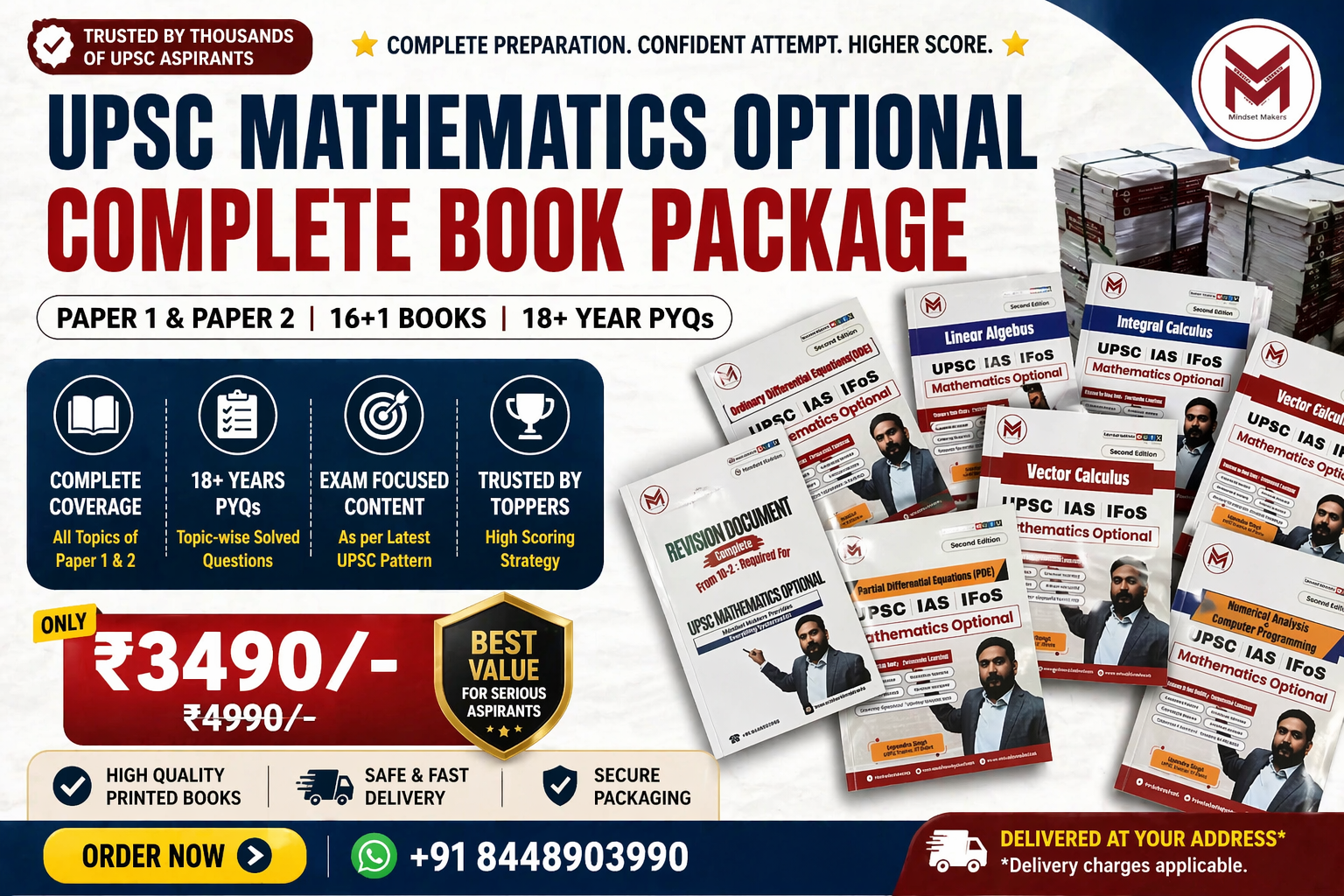
A well-designed combo like the Mindset Makers Paper 1 & 2 Kit by Upendra Singh helps simplify preparation by providing complete syllabus coverage, topic-wise PYQs, and revision-focused content in one place.
👉 The key to success is simple: Concept clarity + PYQ practice + multiple revisions = high score in Maths Optional.