
The Foundation & Booklist Trap
Stop Collecting Thick University Books for UPSC Maths Optional: How Simple Harmonic Motion Reduces to Just Three Checks.
Hello dears,
Every year at Mindset Makers Academy, I meet sincere UPSC Mathematics Optional aspirants who surround their study tables with five or six bulky university textbooks for Applied Mathematics alone. They spend months solving hundreds of scattered exercises in Dynamics and Statics, yet when they sit in the UPSC Mains hall, they freeze on a 15-mark question on Simple Harmonic Motion or lose half their marks to small sign errors.
In my classroom, my students often hear me say one line that I try to live by every single day: “A teacher is a good student only.” Having taught higher mathematics for over 15 years and mentored civil services aspirants as an IIT Delhi alumnus and UPSC Interview Panelist, I have seen one truth hold steady year after year. UPSC does not reward random volume. It rewards clear definitions, calm thinking, and step-by-step mathematical justification.
What 26 Years of UPSC CSE and IFoS Questions Teach Us
When I sat down like a sincere student with 26 years of actual UPSC CSE and IFoS Previous Year Questions for our Mindset Makers 16+1 Books, the noise of thick textbooks simply disappeared. Every single question on Simple Harmonic Motion reduces to just three honest checks.
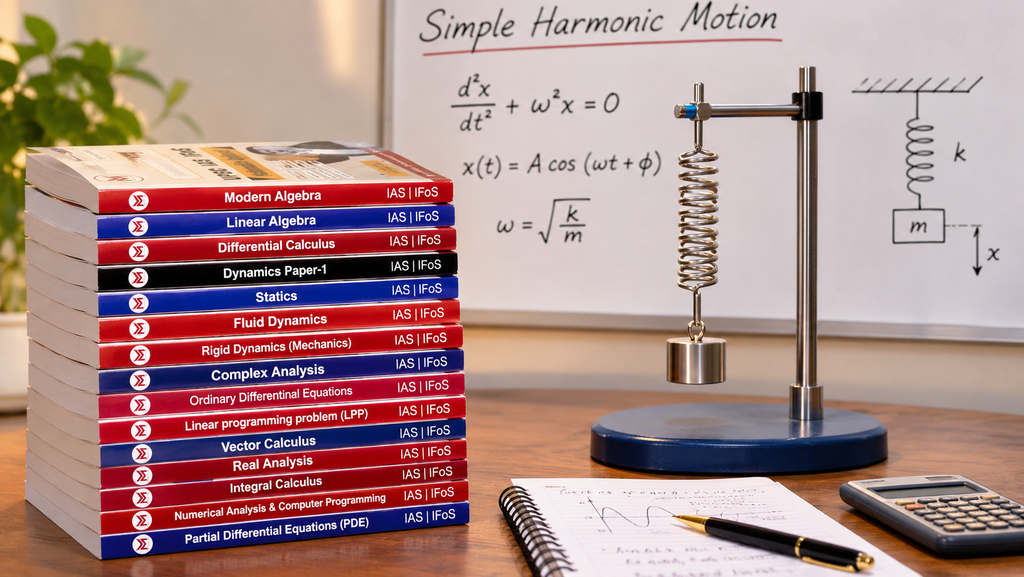
First, you must identify the true static equilibrium centre (x = 0) and never confuse the fixed suspension point or a random reference point on the line with the real centre of oscillation. Second, you must separate slack free-fall intervals from taut Hooke’s law motion, because in vertical and horizontal elastic string problems, a single formula never governs the whole path. Third, you must watch the sign of dx/dt before integrating for time, choosing the positive root when x increases and the negative root when x decreases.
Instead of forcing you to hunt across multiple reference books, Mindset Makers 16+1 Books brings this entire foundation together under one roof by grouping the chapter into three logical categories supported by clear model examples. Stay disciplined, trust one systematic source, and revise your basics again and again.
In the next part of this series, we will open the actual 2026 to 2003 UPSC CSE and IFoS question papers together to see how the examiner repeats and reshapes these exact ideas.
pare in the right way. Keep learning, keep smiling.
— Prof. Upendra Singh (Upendra Sir)
Founder & Director, Mindset Makers Academy